
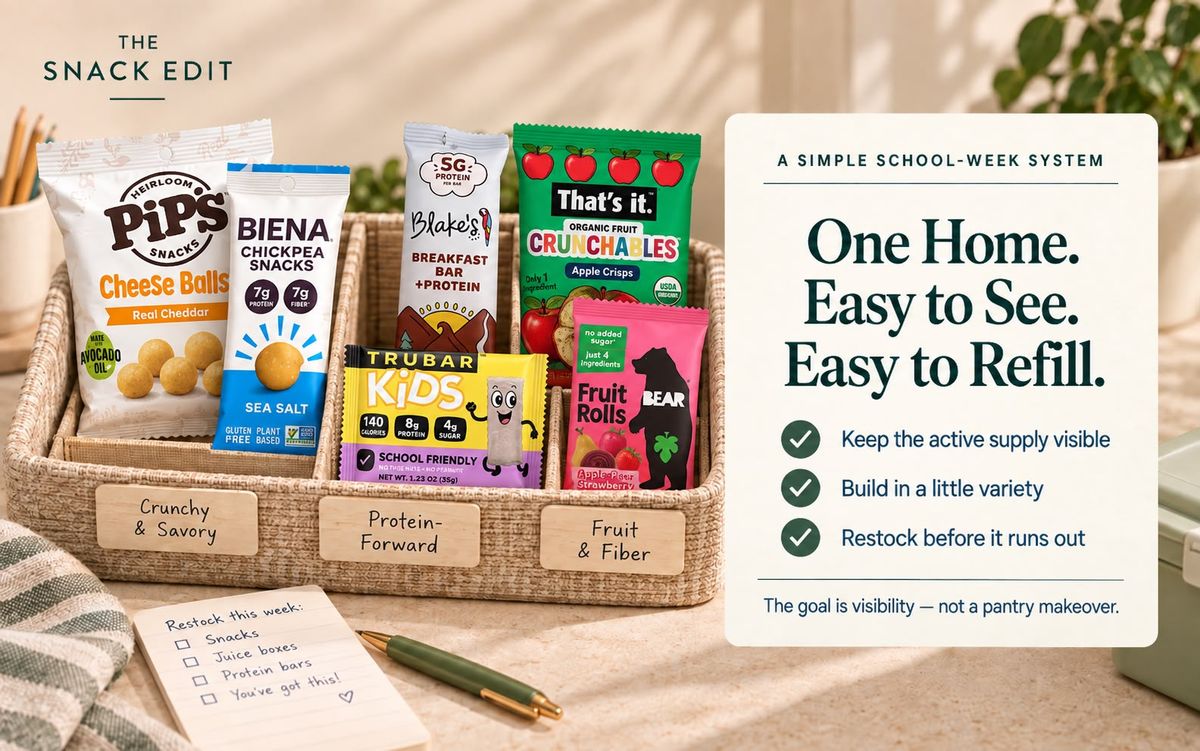
School-snack organization does not need matching containers, a perfectly arranged pantry, or a complicated Sunday routine.
It needs one thing more than anything else: a system you can still use on a busy Wednesday morning.
For most families, that means keeping a useful mix of easy-to-pack snacks in one predictable place and checking the supply before it gets too low.
Here is a simple way to set that up.
Give school snacks one home
The first step is deciding where the school-week snacks live.
That might be one pantry shelf, a drawer, a basket, or part of a cabinet.
The exact container does not matter very much. What matters is that you do not have to search three cabinets every morning to find something packable.
If some of your regular snacks require refrigeration, you can use the same idea in the refrigerator: one easy-to-see area for items meant for school or grab-and-go use.
The goal is visibility, not a pantry makeover.
Organize around how the snacks are used
It can be tempting to organize everything by brand or package shape. For a school week, grouping by use can be more practical.
You might mentally divide the supply into crunchy and savory choices, fruit-based options, protein-forward picks, and a few sweeter choices.
It does not have to be precise. The point is simply to make different types of snacks easy to see so that the same thing does not automatically get packed every day.
That is also the idea behind our broader School Snacks for Kids guide: practical variety is often more useful than having a large quantity of one single option.
Keep the current supply visible
A school-snack system works better when you can tell what is running low.
Deep bins filled with several layers of snacks may look organized, but they can make it harder to see what is actually left.
Try to keep the active supply visible enough that a quick look answers basic questions: Are there still crunchy options? Are most of the fruit-based choices gone? Are a few bars hiding behind a large stack of something nobody is choosing?
You do not need a spreadsheet. You just need enough visibility to make the next restock easier.
Do not overfill the snack area
More snacks do not always make the system easier.
If the drawer is packed so tightly that new products get pushed behind older ones, you can end up buying more while forgotten snacks sit in the back.
A smaller rotating supply is often easier to manage. Use what is already open and available before automatically adding more of the same thing.
If an option repeatedly comes home uneaten, that is useful information too. The goal is not to maintain a perfect inventory. It is to learn what your family actually uses.
Build in enough variety for different days
Children do not always want the same thing every day. School schedules are different too.
Some mornings call for the easiest thing to grab. On another day, a child may want something crunchy. An after-school activity may make another type of snack more practical.
Keeping several snack styles available gives families choices without requiring a new grocery decision every morning.
You do not need ten versions of every category. A little variety goes a long way.
Make individually packaged options easy to reach
When mornings are rushed, individually packaged snacks have an obvious advantage: they can usually go directly from the pantry into a lunchbox or backpack.
That does not make an individually packaged product automatically appropriate for every child or school. Ingredients, allergens, Nutrition Facts, and school rules still matter.
Our guide to individually wrapped snacks for school explains those checks in more detail.
From an organization standpoint, though, the value is simple: fewer morning steps.
Pick one restocking moment
The easiest time to restock school snacks is before the useful options are completely gone.
Choose one point in the week when you naturally have a chance to look at the supply. For one family that may be Friday afternoon. For another it may be Saturday morning or Sunday evening.
The particular day is less important than making the check predictable.
Look at what is left, notice which categories disappeared first, and decide what actually needs replacing. That turns restocking from an emergency grocery stop into part of the normal week.
Let real use change the system
A good snack organization system should change with your family.
If one product consistently comes home, stop buying so much of it. If one type disappears in two days, keep a little more of that style on hand. If mornings still feel chaotic, move the most-used options somewhere easier to reach.
The system is there to help the family. The family should not have to maintain the system for its own sake.
Where The Snack Edit fits
The Snack Edit was built around one piece of this problem: keeping a varied supply of individually packaged school snacks ready without having to build the assortment one full multipack at a time.
Our job is not to organize your pantry. It is to make the restocking part easier.
Whether you buy snacks individually, use a curated box, or mix the two, the same principle applies: keep useful options visible, keep enough variety on hand, and restock before the next busy morning forces the decision.