
Packaged snacks can make busy school weeks a lot easier.
They fit into lunchboxes, require little or no morning prep, and can stay ready in the pantry when there is no time to make something from scratch.
The difficult part is choosing between them.
A package may say “made with whole grains,” “no artificial flavors,” “organic,” or “good source of protein,” but one phrase on the front does not tell you how the snack fits into your child’s day.
A more useful approach is to turn the package around.
You do not need to analyze every gram or find a nutritionally perfect snack. A few quick checks can tell you much more about what you are buying.
So what should parents actually look for when choosing healthy packaged snacks for kids? Start with the label, then consider how the product fits into the school day.
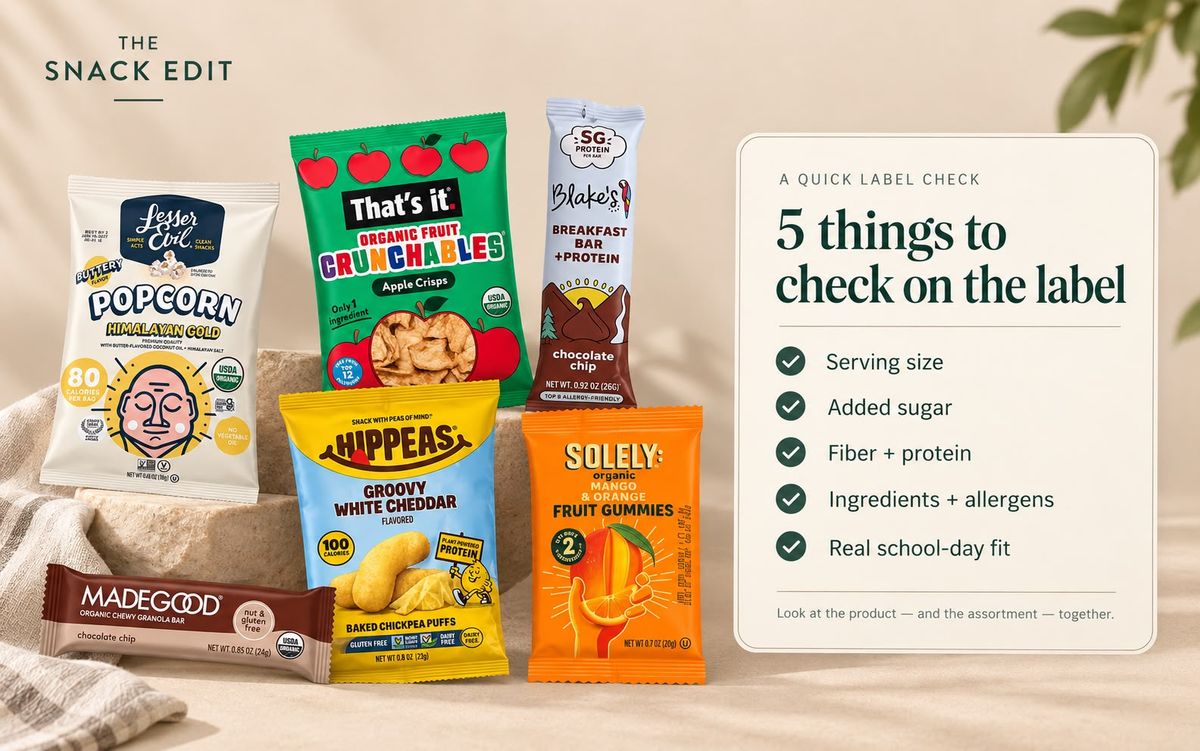
A useful label check starts with serving size, added sugar, fiber and protein, then ingredients, allergens, and whether the snack actually works for your child’s school day.
Start with the serving size
Before comparing calories, sugar, fiber, or protein, check what amount the Nutrition Facts panel is actually describing.
The FDA notes that serving size reflects the amount people typically eat; it is not a recommendation for how much someone should eat. All of the nutrient numbers on the panel apply to that listed serving. See the FDA’s guide to the Nutrition Facts label.
For individually packaged school snacks, this is especially useful because a small package may look like one serving without necessarily being one.
If you are comparing two products, make sure you are comparing roughly similar serving sizes.
Look at added sugar separately from total sugar
Total Sugars and Added Sugars are not the same thing.
Total Sugars can include sugars that naturally occur in foods such as fruit or milk. Added Sugars shows sugar added during processing, including ingredients such as table sugar, syrups and honey.
That does not mean a school snack needs to contain zero added sugar.
For us, the more useful question is how that sweetness fits with everything else in the snack and in the overall mix.
A cookie and a fruit-based bar do not need to play the same role. What matters is understanding what you are choosing instead of assuming that every product needs to meet one identical rule.
Check for fiber
Fiber is another useful comparison point, especially when choosing between similar products.
Two crackers, bars or fruit-based snacks can look almost identical from the front of the package while having very different amounts of fiber.
We do not expect every school snack to be high in fiber. Instead, we look at the overall assortment.
One product may bring more fiber, another may be more protein-forward, while another may simply provide a convenient crunchy option kids enjoy.
Protein can be useful, but more is not automatically better
Protein is easy to notice because many snack brands highlight it on the front of the package.
It is still worth checking the actual grams on the Nutrition Facts panel.
For school snacks, we think of protein as one part of the bigger picture rather than a contest to find the highest number.
Use % Daily Value as a quick comparison tool
You do not need to memorize nutrition targets to make use of the label.
For nutrients that show a % Daily Value, the FDA gives a simple general guide: 5% DV or less is considered low, while 20% DV or more is considered high. The FDA explains how to use % Daily Value here.
That can be useful when comparing similar products for fiber, added sugar, sodium or saturated fat.
The important word is compare. A label is most useful when it helps you choose between realistic options, not when it turns snack shopping into a math assignment.
Read the ingredient and allergen information too
Nutrition Facts are only part of the package.
If allergies, dietary needs or school rules apply, read the ingredients and allergen information for the individual product.
FDA-regulated packaged foods in the United States must identify major food allergens used as ingredients. Families managing allergies should always review the individual product label. Read the FDA’s food-allergy label guidance.
The Snack Edit does not choose products that contain peanuts or tree nuts as ingredients. However, The Snack Edit is not an allergy-free service, and individual products may be made in facilities that also handle common allergens.
For more on packaging and school-specific checks, see our guide to individually wrapped snacks for school.
Do not let one number decide whether a snack works
It is tempting to create one rule: no added sugar, high protein, only five ingredients, or organic only.
Real school weeks are usually more complicated than that.
A useful snack also has to be something your child will eat, something that fits into the time available at school, something you can reasonably keep stocked, and something that works with the other foods they eat during the day.
That is why our Healthy School Snacks guide looks at the whole picture: ingredients, Nutrition Facts, protein, fiber, added sugar, portability, variety and real school-day fit.
A quick label check for busy parents
When there is no time to compare every detail, start with five questions:
- What is the serving size?
- How much added sugar does the serving contain?
- Does the snack contribute fiber or protein?
- Are there ingredients or allergens I need to check?
- Will this actually work for my child’s school day?
That will not tell you whether a snack is “perfect.” It will tell you much more than the front of the package alone.
How The Snack Edit uses labels
When we evaluate packaged snacks for an Edit, we do not look for one magic number.
We look at the product and the assortment together.
That includes ingredients, Nutrition Facts, protein, fiber, added sugar, serving size, portability, variety and whether the product makes sense in a real school-week routine.
Some snacks are protein-forward. Some are fruit-based or fiber-containing. Some bring crunch. Some are treats.
The goal is not to make every item identical. It is to build a useful mix.